


An interactive scientific exhibition
Can You Stop Time?
Play of Time is a timing trainer built around one deceptively simple task: press, wait, and stop at exactly three seconds. The point is not the timer itself. The point is what the timer reveals about perception, rhythm, self-control, and the body’s response to a very small interval.
What follows explains why it works — then puts the timer in your hands. Play now →
Premise
Everything we do happens in time
Video explanation of the Play of Time idea
Whatever we do, we do it in time — the sharper that sense, the more manageable everything built on it becomes. Play of Time strips the idea down to one task: no multitasking, no distractions, just your own mental and motor speed against a fixed target. One repeated attempt teaches more than a paragraph of explanation — which is why this is a game, not a lecture.
Training
What it trains — and where it carries over
- Perception of very short time intervals, down to milliseconds.
- Synchronization between perception and movement.
- Voluntary control over functional state.
- Attention, internal rhythm, and emotional regulation.
- Self-control in conditions that are simple but not easy.
It looks like nothing more than press-and-stop. In practice it surfaces patterns in attention, anticipation, and motor timing you can't see from the inside — useful in sports where timing shapes the result, in meditation and body awareness, and as a quick read on which kind of day you're having before it costs you something.
Control
The main lever is excitation and inhibition
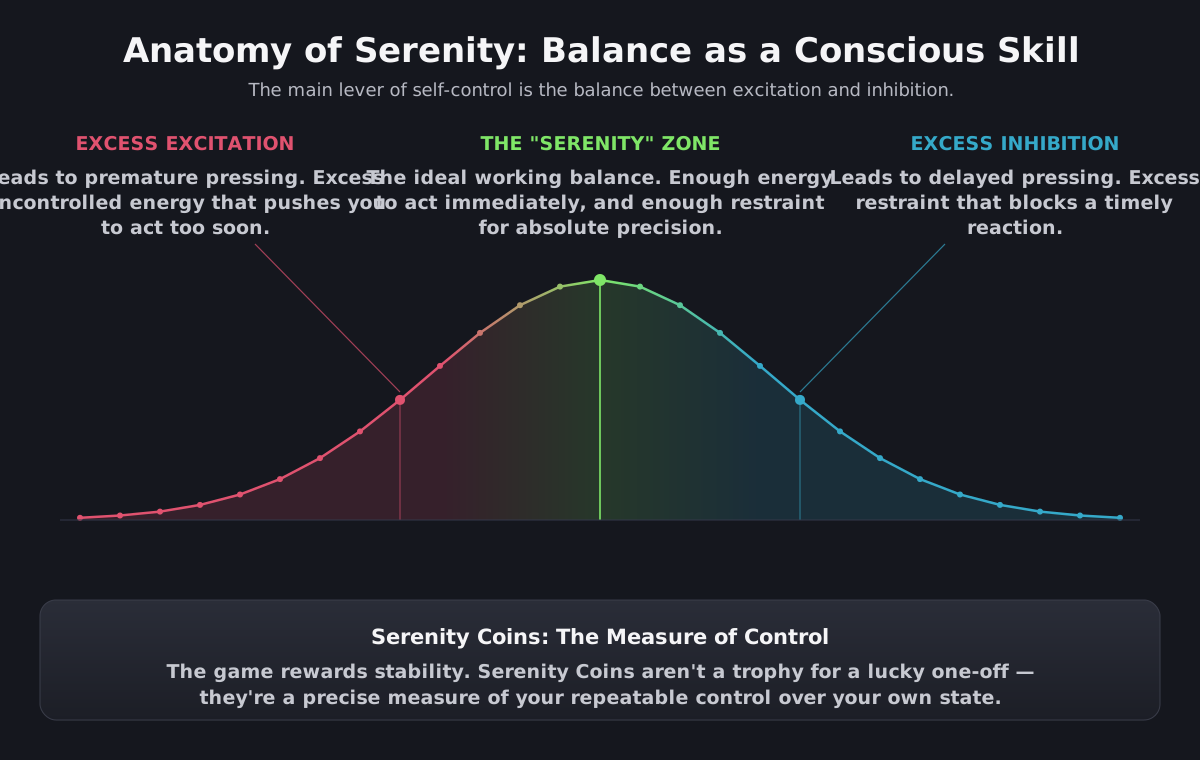
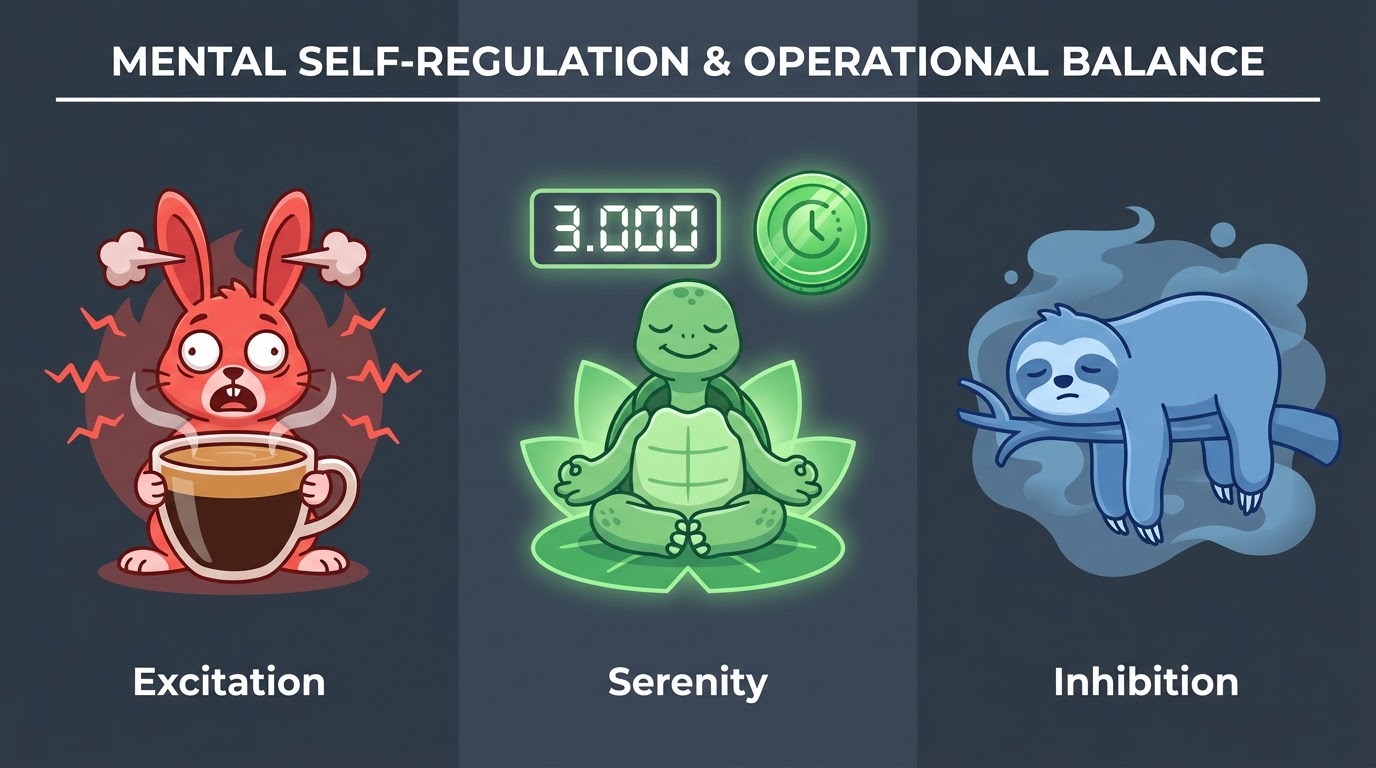
Too much excitation and the response comes early — an overcorrection that races ahead of the target. Too much inhibition and it comes late — caution that overshoots the moment. Play of Time calls the narrow zone between them serenity: not calm as a mood, but calm as a working state you can return to on command.
Serenity Coins measure that state directly. They aren't a reward for one lucky press — they accumulate only when your control is repeatable, attempt after attempt, which is what makes them a genuine record of self-regulation rather than a trophy for chance.
What the numbers show
Luck is not mystical here
Imagine 2,001 possible outcomes on the stopwatch — only one of them lands exactly on 3.000. Real people aren't random number generators, and that gap between chance and actual performance is what the game turns into the Luck Coefficient: a running measure of how far your results diverge from pure randomness.
Every player also drifts in a personal way — some run early, some run late, and the tendency shifts with mood, fatigue, and rest. The quest system reads that timing profile continuously and adapts its targets to it, so progress reflects your own drift correcting itself, not a fixed external standard.
Research
Inspired by the work of S. Gellerstein
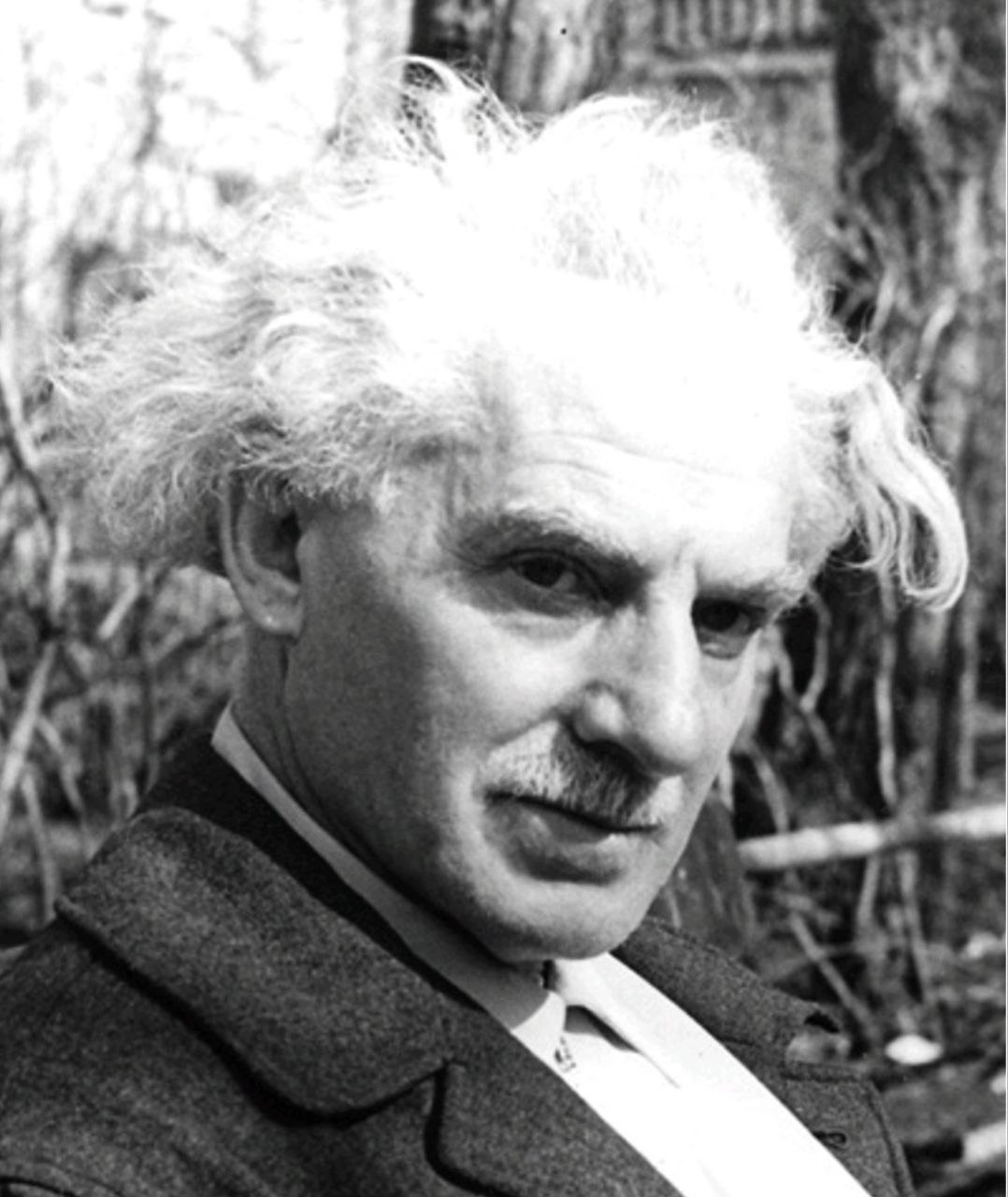
The scientific grounding comes from S. Gellerstein's research into how people perceive and act within very short intervals — work rooted in real performance under time pressure, not laboratory abstraction. This project doesn't try to turn that research into a lecture; it translates the idea into something felt, not read.
The deeper aim is to isolate micro-interval control as a skill in its own right, separate from raw reaction speed. Once it's learned deliberately — through repetition, not instruction — the expectation is that it spreads: into movement, concentration, and the general ability to stay aligned with whatever you set out to do, under pressure or not.
Play
Tap and play
or download app apk for Android